Showing posts with label UARD. Show all posts

Tuesday, March 29, 2016

UARD: Desk Service/ Reference Service

On my last section of the UARD section. I did reference work.

I was given the task to look at every Philippinensians specifically years from 1950's to 1960's and look for the ROTC section and give it to the librarian on duty.

The librarian oriented me at how the organization of the archives section. So basically some are not in sequence. For example the 1960's are not near the 1950's or that the other works of  particular author has another set of collection hidden in a room but it can be borrowed and browse. 


After finishing the task and orientation, I sat down at the reference desk and waited for a reference request.


Reference Desk in the Archive Section


I have to say that even though Archive work is a bit... dull. I like the historical vibe I get when entering in that section. Though the organization is a jungle, I got the hang of it afterwards. In my interpretation; archives work is about sorting through the files, organizing them and preserve them.


UARD: Scanning


Scanning is part three out of four parts in UARD.

I was orientated at how to do scanning because scanning is not like photocopying where you put the book, press the buttons and boom! finish!

On scanning there is a particular software for it. I was given a University of Philippines Diliman General Catalogue.

My first scanned book


Open the software.

Make a new folder for your scanned items and files

Scan the cover and content of the books and back cover. Make sure you get it clear and precise.

Save the scanned items.


**Note: there are limited memory per scan file. Meaning you have to make another file and save it in the folder and scan again.


After scanning the UPD General Catalogue. I was given a heavy and worn out book: The Philippinensians.

My second scanned book

The Scanning Process


UARD: Sorting

One my part 2 of OJT in the UARD. I did sorting.
My sorting workstation

Basically in UARD your 45 hours is segregated in four sections: Bindery. Sorting, Scanning and Desk Service.

Upon starting my sorting duty, the staff taught me how to do the proper sorting.


Step one: Remove the staple/s on the paper and replace it with paper clip


Step two: Sort it by their date. Be cautious cuz in a piece of paper there are more than one date so see which is the very recent date.

Step three: Once it is sorted. Put them in a folder and label it.
Sorting Sample 1
Sorting Sample 2
Step four: Put them in a box specifically for the folder or your own box.


What was annoying about sorting is that the staples are so rusty that my eyes got irritated. What was funny about sorting; I was only taught how to properly remove the staples after I finished my section in sorting. I used the typical stapler remover or clipper and not the blue one.


UARD: Bindery last moments

March was not my month since I only did my OJT once a week. Yes this month was not my month so I was back tracked by a mile.

When I returned to the bindery section I was introduced by the eve present Pearl Glue scent and my unfinished work. 

I was introduced at how to hammer in and shape the spine in a concave manner. It needs finesse and accuracy that I still don't get. After which I got introduced to other types of sewing methods. So far I know the cross over and the usual sewing method that I forgot the name. I did as well the book cover of the books.

I'll miss this workstation of mine

The letters for stamping 

The Stamper

The compressor

The materials

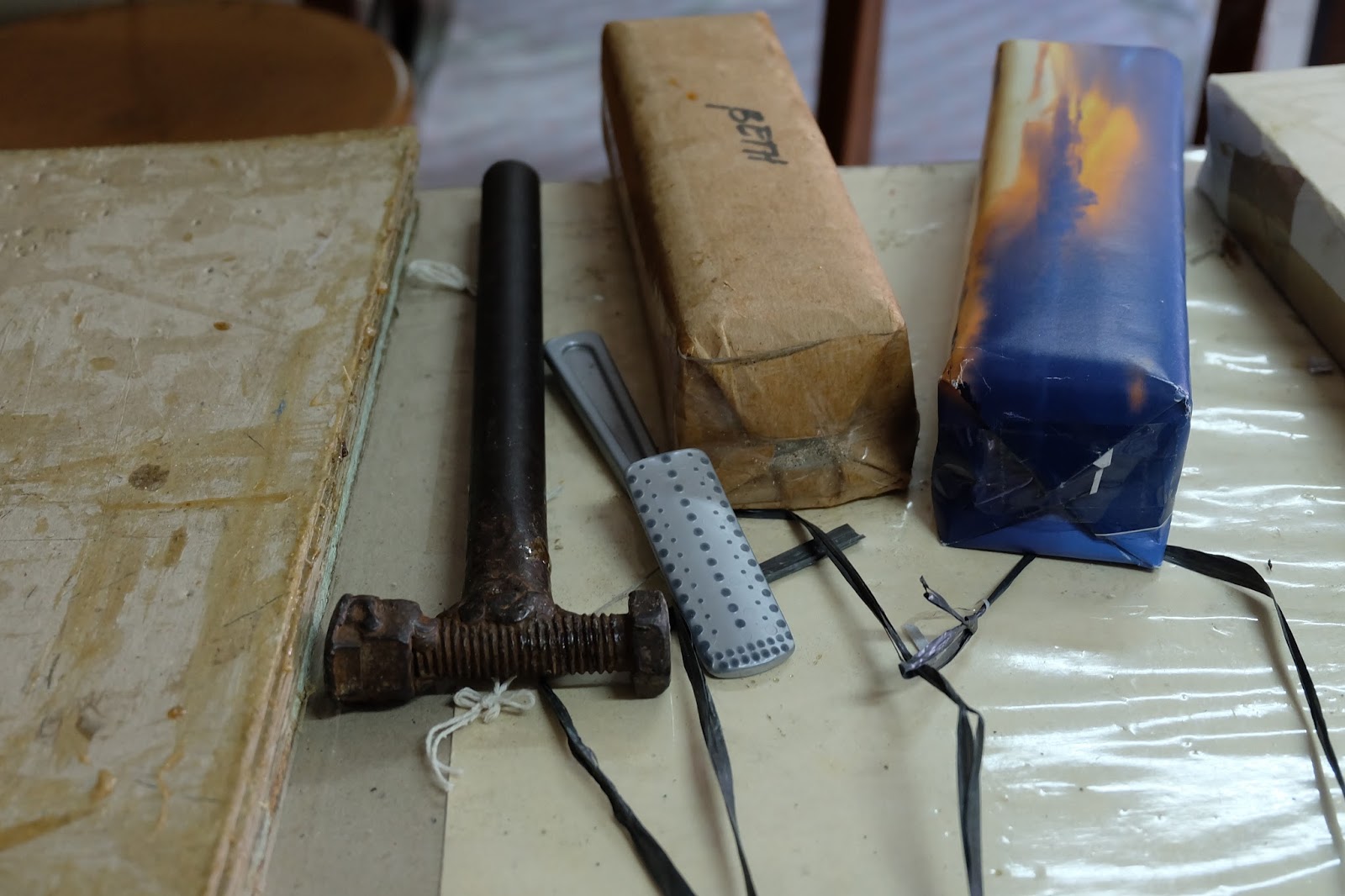
The hammer

The scissors and nails

The "other" materials


Covering the books can be difficult since it must be smooth and the spine must be perfect. Honestly I will never understand how Sir can say that what I did was not on point when in my point of view it is. 

Binders Eye of View.

What I like the most in Bindery was marking the books with their title and author with the stamper. It was a bit tedious but I got the hang of it after a few trials.

Bindery is a man's work (sorry for being sexist). I am not "cut-out" for Bindery.

The outcome


Wednesday, March 23, 2016

UARD: Bindery


Upon entering the bindery section, I was attacked by the awful and nauseating smell of animal glue or Pearl Glue used in binding and repairing books. I would rather smell Elmers Glue right about that time. I meet Sir Lamuel the head (?) and I think only personnel in binding all of the need-to-be-binded books and other reading materials. He is within his fifties (I guess), which worried and amazed me at the same time. Worried because he may retire soon and the library hasn’t found a replacement for him yet (from what I observed) or rather haven’t trained anyone who is willing to stay at that four-wall room smelling of old books and the ever-present Pearl Glue. Amazed because doing bindery isn’t an easy peasy lemon squeezy work and the fact that he still has the power to do tedious work such as this is worth applauding.


I was taught the basics, introduced me to the working area, and taught me how to use the cutter. Sir warned me about the giant cutter – that I might cut my thumb without notice and since then I got afraid of using it. I am good with scissors thank you! I kept on trying and cutting pieces of cardboard and 70 % of my trials are fails and Sir assists the other 30%.

My work station

PEARL GLUE

Bindery Guidelines


It’s hard especially since I am a left-handed person. Turns out that if you’re a left hand and your doing this for the first time, it will be a little hard since the world is more declined to right handed people. 


I got two books, one I almost destroyed due to miscommunication--Sir talks deep Filipino and I am not really good at Filipino. Like in the cutting trial, Sir assisted me again and I got to remove the spine and poke a hole for the needle and thread to pass through and sew.


I didn’t know that until I got to the bindery section. There is the crossover that I did to the book I unintentionally mildly damage and the ordinary sewing that I did to another book.

That’s basically what I did in my first hours in the bindery section.


I made a guess that it is probably that fact that the book is published 5 years or so that its time to preserve it. Then another question goes into my head: what is or are the signs or criteria that its time for a book to be given to the bindery section (besides the obvious for example the loosing of pages from its spine)?